
Book Description
About the Book
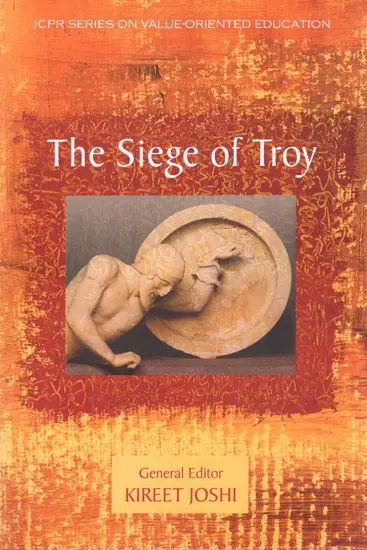
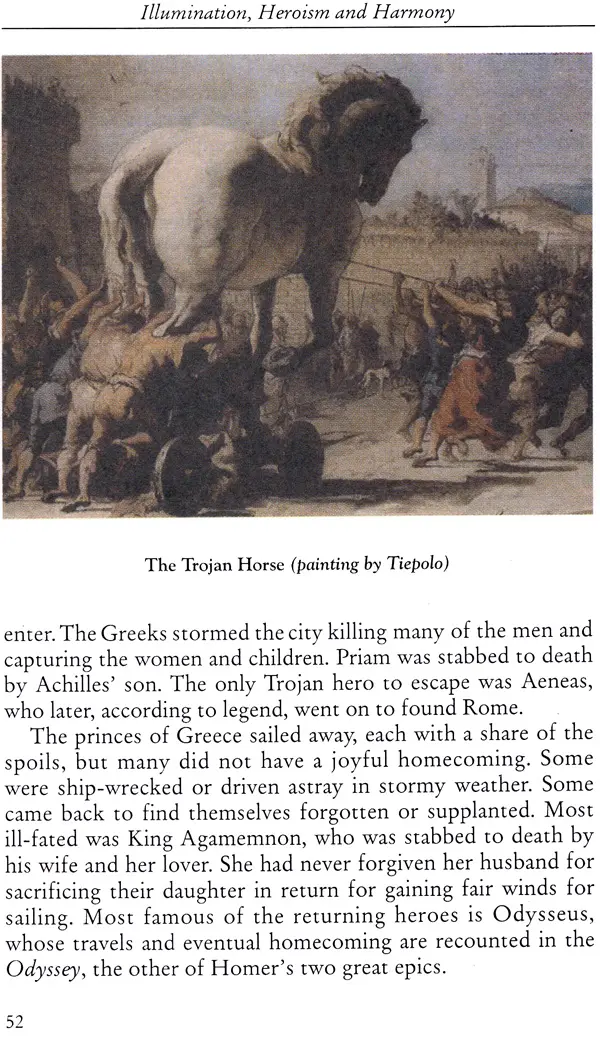
Ilumination, heroism and harmony are three major powers that can uplift life to higher and higher levels. It may be useful to explore and illustrate the meanings of these three terms by giving examples of those qualities through appropriate stories. The story of the Siege of Troy in the Iliad gives us a striking example of a hero in Achilles. He is a man who abides in the human dimension temporarily ruled by anger and grief, but is pulled godward by his own godlike nature’s response to the call of the gods to work out a divine purpose at Troy. Achilles fulfills his social obligations and earns honor and glory through his physical courage and prowess as a warrior. He reveres the gods and listens to their guidance, and finally, at the climax of the Iliad, is able to express pity and mercy and compassion to his Trojan opponent, Priam. The momentous meeting between the greatest of the Greek warriors and the Trojan king has been arranged by the gods who are outraged by the fact that Achilles is defiling the body of defeated Prince Hector. Achilles is told point blank by his goddess-mother, Thetis, that he must hand over the body of Hector in return for a ransom. Achilles’ immediate reaction is to submit himself to the divine will. When the noble king Priam and the long-wrathful Achilles finally meet, there is a momentous change. These bitterest of enemies, gaze at each other – soul to soul – and reach a state of compassion in which they mourn each other’s losses and grieve over the losses that all men experience in the field of war. They part and each goes on to his own severe fate, but readers of generations live inspired by their reconciliation, by the example of men uplifted into a diviner sphere. It is this eternal moment that Homer has immortalized for his own people and for all men and women whoyearn to be free from the lower nature and to live in the highest part of themselves.
Preface
The task of preparing teaching-learning material for value- oriented education is enormous.
There is, first, the idea that value-oriented education should be exploratory rather than prescriptive, and that the teaching-learning material should provide to the learners a growing experience of exploration.
Secondly, it is rightly contended that the proper inspiration to turn to value-orientation is provided by biographies, auto-biographical accounts, personal anecdotes, epistles, short poems, stories of humour, stories of human interest, brief pas-sages filled with pregnant meanings, reflective short essays written in well-chiselled language, plays, powerful accounts of historical events, statements of personal experiences of values in actual situations of life, and similar other statements of scientific, philosophical, artistic and literary expression.
Thirdly, we may take into account the contemporary fact that the entire world is moving rapidly towards the synthesis of the East and the West, and in that context, it seems obvious that our teaching-learning material should foster the gradual familiarisation of students with global themes of universal significance as also those that underline the importance of diversity in unity. This implies that the material should bring the students nearer to their cultural heritage, but also to the highest that is available in the cultural experiences of the world at large.
Fourthly, an attempt should be made to select from Indian and world history such examples that could illustrate the theme of the upward progress of humankind. The selected research material could be multi-sided, and it should be presented in such a manner and in the context in which they need in specific situations that might obtain or that can be created in respect of the students. The research team at the Sri Aurobindo International Institute of Educational Research (SAIIER) has attempted the creation of the relevant teaching-learning material, and they have decided to present the same in the form of monographs. The total number of these monographs will be around eighty to eighty-five.
It appears that there are three major powers that uplift life to higher and higher normative levels, and the value of these powers, if well illustrated, could be effectively conveyed to the learners for their upliftment. These powers are those of illumination, heroism and harmony.
It may be useful to explore the meanings of these terms -illumination, heroism and harmony – since the aim of these monographs is to provide material for a study of what is sought to be conveyed through these three terms. We offer here exploratory statements in regard to these three terms.
Illumination is that ignition of inner light in which meaning and value of substance and life-movement are seized, under-stood, comprehended, held, and possessed, stimulating and inspiring guided action and application and creativity culminating in joy, delight, even ecstasy. The width, depth and height of the light and vision determine the degrees of illumination, and when they reach the splendour and glory of synthesis and harmony, illumination ripens into wisdom. Wisdom, too, has varying degrees that can uncover powers of knowledge and action, which reveal unsuspected secrets and unimagined skills of art and craft of creativity and effectiveness


Reviews
There are no reviews yet.