The conversations that took place in these meetings were recorded and what appears in the book is a very lightly edited version of the recorded conversations. The philosophically interesting aspects of these conversations are the views expressed by various participants on the human condition, the ethical grounding of human life, the dividing line between life and death, and about their institutions for educating the young and dispensing justice.
The book aims to achieve a twofold objective: (1) to secure an authentic articulation of the traditional Ao world through a dialogue between different Ao voices (an aim pursued very differently from the anthropologist’s participant observation), and (2) clearing the ground for the reflection of philosophical insights thrown up in the process of this articulation. The insights will be obvious to the sympathetic and discerning reader; the reflection is left to those who will read the book with serious philosophical interest.
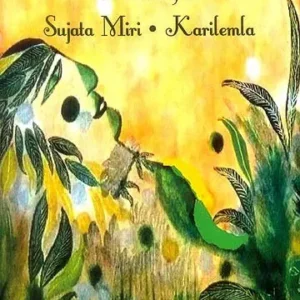
Sujata Miri’s paintings are an insightful addition to the dialogic explorations of the book.
Karilemla hails from a tribal community of India’s north-east, the Ao Naga tribe. She grew up in Sungratsu village. She is a research scholar in philosophy. She studies at the Indian Institute of Technology Bombay in the Department of Humanities and Social Sciences. Her research interests include continental philosophy, especially Heidegger’s critique of culture, philosophy of technology and the Ao Naga culture of India. She was a Fulbright scholar at Emory University, Atlanta, USA in the Fulbright-Nehru Program in 2013-14.
The book consists of recorded conversations about traditional Ao practices, beliefs about the human condition, the ethical grounding of human life, the dividing line between life and death, and about their institutions for educating the young and dispensing justice.
The purpose of the conversation is two-fold: (1) to secure an authentic articulation of the traditional Ao world through a dialogue between different Ao voices (an aim pursued very differently from the Anthropologist’s participant observation), and (2) clearing the ground for the reflection on philosophical insights thrown up in the process of this articulation. The insights will be obvious to the sympathetic and discerning reader; the reflection is left to those who will read the book with serious philosophical interest.
The conversation is free flowing and continuous – only very gently guided by the Visitor, a retired University Professor of Philosophy. There is, therefore, no sharp division of the book into distinct chapters. The “chapterization” however very roughly follows thematic distinctions and the chronological order of the original. The book also includes a few paintings by Sujata Miri in the hope that they might add a different dimension to our understanding of Ao narratives. A note about the paintings is added at page ix.
Prof. Temsula Ao a noted personality of the North-East and a valuable friend actively participated in one of our sessions with the Ao elders. We are immeasurably grateful to her for her time and contribution. We owe special thanks to Dr Sashinungla Ao of the Department of Philosophy, Jadhavpur University, who gave us immense help in making our understanding of Ao heritage more systematic and focused. Dr C. J. Thomas, Deputy Director NERC, ICSSR, Shillong was always with us in planning, hospitality and recording of our meets. His cooperation was invaluable. So also the assistance provided by Abhishek Kumar, a doctoral research student of Delhi Universty, who put up with us through a long period of trial and error in shaping the manuscript. While the list of elders who form the backbone of the dialogue is attached in the Appendix, we would like to put on record our special gratitude to Mr Lipoktsungba Aier and Mr Samatoshi Walling for their guidance in locating and introducing us to the elders.
Freedom from disciplinary control also means freedom from philosophical intrusions – with its very broad meaning. But there are many things said during the conversation which can serve as telling reminders to philosophers in precisely the sense in which Wittgenstein talked about the philosophical importance of assembling reminders.
In this Introduction I shall touch upon aspects of the conversation which the philosopher might find interesting.
Origin and History
The talking session begins with stories of origin. It is interesting that Aos consider what might be called “historical” speculation about their place of origin and migration from there to what came to be Ao country as irrelevant to the understanding of their culture, and even disrespectful to Ao heritage. Tako Jamir’s story is generally accepted:
A man from Changki village named Ajangtoi expressed the view that Aos did not emerge from the six rocks in Chungliyimti but belonged to the Mongolian race and must have migrated from somewhere. On hearing this, a heavy penalty was imposed on him by the community.
The striking image of “bursting forth” from six rocks is deeply embedded in the collective consciousness of the Aos. This consciousness has a cognitive strength enhanced by an emotional commitment that is largely definitive of Ao identity itself. One would therefore need to think about issues such as possible externality of “history” to a community’s sense of identity, the connection between authenticity of mythical “memory” with its ramifications in the complex network of meanings in the body of Ao imaginings and cognitive enterprises and articulation of identity itself. Such an articulation of identity must be distinguished from identity derived from a “memory” – mythical or otherwise – imposed upon a community by external agencies through political and cultural domination: colonial exploitation, religious coercion and so on. Authenticity here is internally connected with an unfailing sense of autonomy.
Songs
It is pertinent here also to reflect on the importance of songs as a binding force of the culture. The text has a large number of songs, which, in English translation, appear soulless. But in the original they have a powerful emotional content and the images have deep multiple resonances. As frequently asserted during the conversation a song – traditionally received – settles a point about life and culture. Product of collective imagination, songs come down from generation to generation and have an objectivity free from deviations through private manipulation. In the words of several of the “elders” songs owned by the community “validate” the culture and ensure its continuity. The emotions embodied in the songs also evoke a strong sense of oneness with the culture.
Rituals
As in all communities rituals are an important part of Ao cultural and religious life. Unlike modern societies, the secular / sacred distinction does not exist for the traditional Ao; also religion is embedded in the culture – thus the culture/religion distinction is also spurious. But rituals which are connected with crucial events of human life have a very special status. They must be performed with meticulous correctness, and strict standards of purity must be observed.
I would like to inform everybody that they would consult the sangmongtsu (soothsayer) as to whom to choose to perform the ritual in order to ask God’s healing of sickness and also for his blessings. Once a person is chosen he makes himself physically clean, will not eat anything even in his children’s house. This is how they maintained purity in order to perform rituals. It is considered more important than animal offering.
Rituals ensure temporal continuity between the past, present and the future; it is, therefore crucial that they themselves have the character of atemporality – a sense of transcendence of time and temporal contingencies.
Man and Animals
In Ao thought there is a clear divide between man and animals:
In the beginning, god made two types of meimchir: One is known as human beings, who have a social and a cultural life, and the other is known as animals that do not have a society. To be truthful and to attain salvation was the highest goal of human life.
Also man has language in which to communicate with one another; animals do not.
Animals and plants cannot communicate with others but humans can. This is one of the reasons why they thought that it is better to be born in human form than as animals and plants.
Society, culture and language are inseparably linked; and it is language that makes the distinction between true and false possible. It may be philosophically extremely instructive to reflect on the link between society, culture, language and truthfulness being the highest goal of human life.
The Mind
The following rather apologetic statement is revealing: Ao vocabulary is very poor. We don’t have a separate word for mind. If we wish to say that “your mind is not working”, we simply say “your brain is not working”. In our language the word tekolok (brain) is used for mind.


Reviews
There are no reviews yet.